Edge to Exascale Integration
Leading streaming AI-based accelerated analysis through the whole of the computational ecosystem.
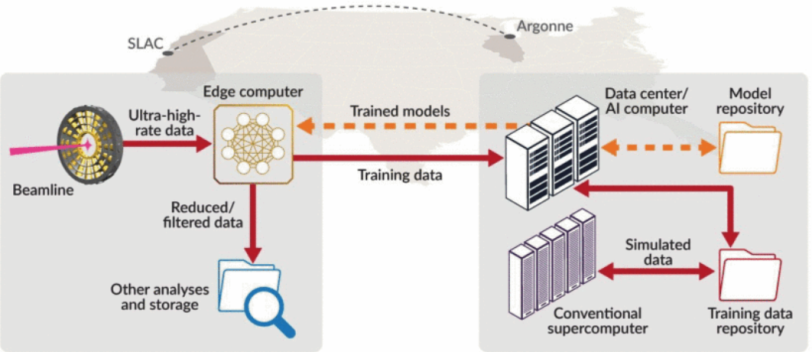
Key Areas
- Low-Latency, Real-Time Computing at the Edge
Focus on deploying AI and streaming data-processing systems directly at or near the data source to enable immediate control actions, self-driving experiments, and critical feedback loops. - Advanced Intelligent Controls
Develop adaptive, AI-driven control frameworks that integrate real-time sensor data, predictive models, and reinforcement learning to dynamically optimize accelerator and experimental operations with minimal human intervention. - Seamless Data Continuum from Edge to Exascale
Develop algorithmic interconnection and networking strategies that allow data to be processed, filtered, and transmitted continuously—from sensors to Exascale computing facilities—without disrupting workflow. - Resource- and Resilience-Aware Algorithms
Design data-processing frameworks that adapt to varying computational resources, handle failures gracefully, and maintain performance under dynamic experimental conditions. - Heterogeneous Hardware Integration
Utilize ASICs, FPGAs, eFPGAs, embedded processors, analog and in-memory compute devices, and commercial accelerators for low-latency inference, data reduction, and real-time control. - Edge-Based AI and Triggering
Implement AI/ML algorithms on edge hardware to perform on-the-fly decision-making, trigger downstream devices, or adjust experimental parameters in real time. - Pre-Processing and Stream-Processing Architectures
Develop methods for intelligent data pre-processing and intermediate stream processing before transfer to large-scale back-end resources such as S3DF or DOE Leadership Computing Facilities. - Power, Security, and Infrastructure Efficiency
Leverage edge processing to reduce energy consumption, enhance cybersecurity via local data reduction or encryption, and minimize physical connections (e.g., detector vessel penetrations). - Benchmarking and Validation via the S3AI Test Bed
Use the SLAC Streaming Artificial Intelligence (S3AI) testbed as a central hub for testing, benchmarking, and refining edge-to-exascale algorithms and hardware implementations across SLAC, Stanford, and the DOE complex. - Co-Design with the SLAC Microelectronics Initiative
Coordinate development efforts where microelectronics innovation—such as custom ASICs or advanced packaging—enables improved edge computing and streaming AI performance. - DOE-Wide Collaboration and User Facility Vision
Position the Edge-to-Exascale pillar as a future user facility supporting national laboratory, university, and industry partners in advancing integrated, real-time data and AI solutions for scientific discovery.
The SLAC EdgeAI team has partnered with a number of private companies and research institutions to construct a streaming sandbox to demonstrate and benchmark unique hardware in the task of ultrahigh throughput AI inference and conventional algorithms for streaming data processing.
SNL is a high-level synthesis (HLS)-based framework developed at SLAC National Accelerator Laboratory to deploy moderately sized neural networks onto FPGAs for ultra-low-latency inference in real-time scientific and autonomous control applications.
Rogue is a modular software framework developed at SLAC to manage high-performance data acquisition, configuration, and control systems for scientific instruments. It provides a Python-based abstraction layer that allows developers and operators to interface seamlessly with complex hardware such as FPGAs, ASICs, and high-speed DAQ devices
The SLAC Ultimate RTL Framework (SURF) is a firmware framework that has been developed by SLAC National Accelerator Laboratory. It is a substantial VHDL library, built upon more than 10 years of development.


