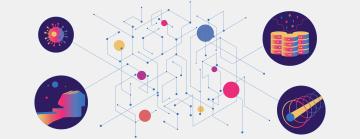
Algorithms, AI/ML → Workflows
AI algorithms are found across all scientific directorates at SLAC, with applications to a wide range of tasks including online data reduction, system controls, simulation, and analysis of big data. An important design principle of AI algorithms is the generalization of learning patterns across different tasks, which motivates shared tool-development and R&D at an inter-directorate level.
Accelerators
We design, build, and operate high-performance accelerators used as scientific research instruments. AI has been applied to accelerator tuning and control, expediting accelerator design optimization, and data analysis and modeling for accelerator diagnostics. Continued development of AI for accelerators is key to delivering the highest accelerator performance for the user sciences.
Cryogenic Electron Microscope
We enable the study of the building blocks of the cell from its smallest constituents to its largest structures through imaging experiments that produce big data at ever increasing resolution and data rate. Development of AI for cryoEM data processing and analysis will have a huge impact on our understanding of the molecular basis of life.
High Energy Physics
We study our universe from the smallest constituents to the largest structure through physics experiments that produce big data at ever increasing precision and rates. Led by SLAC researchers, AI has made an impact in physics simulation, data analysis, and theory.
Linac Coherent Light Source (LCLS)
We use one of the world's brightest X-ray sources powered by our electron accelerator to take snapshots of atoms at work, revealing how the smallest constituents of our world work. SLAC is leading the way of AI at the edge, where fast inference models can help reduce the data load.
Stanford Synchrotron Radiation Lightsource (SSRL)
SSRL is a synchrotron X-ray radiation scientific user facility. Scientists visit from all over the world to view the nanoworld, leading to cutting-edge research in drug discovery, energy efficiency and supply, environmental remediation (toxic waste cleanup), electronics, telecommunications and manufacturing. As light sources enable data to be collected at increasingly fast rates, processing data will become an increasingly daunting problem. At SSRL we are using ML to expedite this process, helping users gain high-level insights on-the-fly.


